
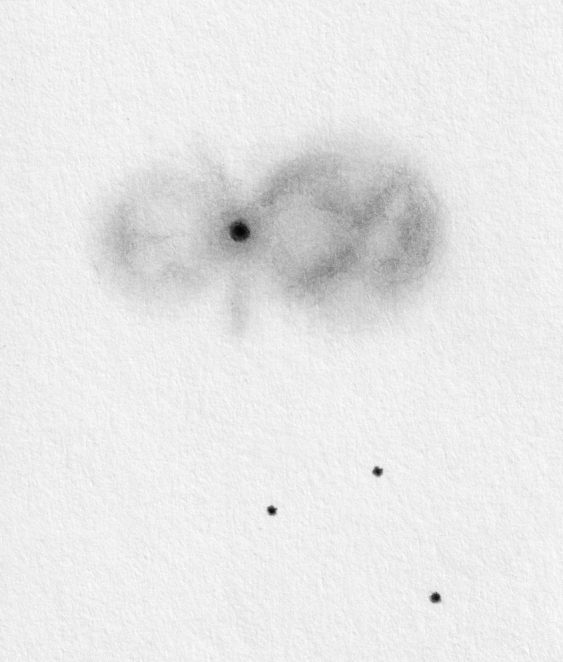
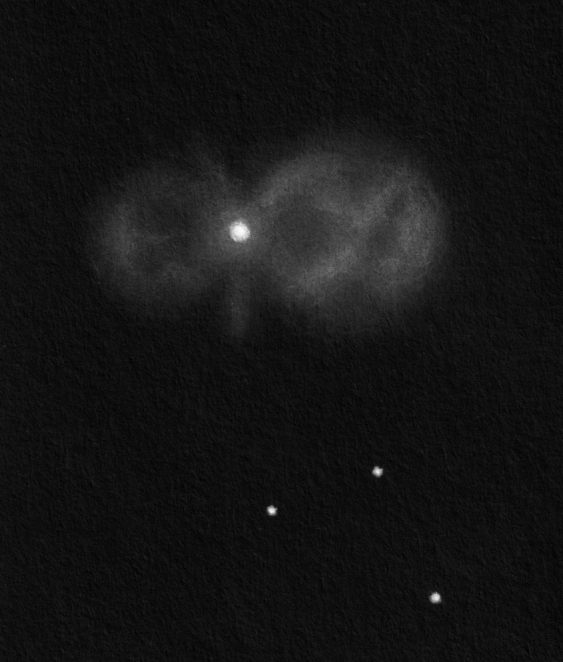
After nearly two weeks of deep-sky observing, we were completely worn out. Everyone was exhausted. As the night progressed, Sanyi took a break for an hour or two, letting me use the 24" telescope. Many thanks to him for that! The target was an obvious choice: the orange-hued cloud of material from the Great Eruption of Eta (η) Carinae between 1838 and 1843, known as the Homunculus ("Little Man"). This region lies in the heart of the much larger Eta Carinae Nebula (NGC 3372). In fact, η Carinae is responsible for the ionization of the entire nebula including the Homunculus itself.
The view through the telescope is pretty much like the Hubble photo. Which is astonishing. The nebula is not particularly diffuse. Its surface features a wealth of high-contrast details. The whole nebula is inhomogeneous. Seeing was not perfect, fluctuating on a timescale of about 10 seconds between "very good" and "unusable". This significantly slowed down the sketching process. Though I could reliably count on those few-second intervals when the details were reasonably sharp. The nebula has an orange color which is very apparent at lower magnifications even in a smaller (16") telescope. At the center, the diffraction spikes of η Carinae made the sketching process more difficult. I have omitted them from the drawing. The nebula measures approximately 18" across which is very small, roughly the apparent size of Saturn’s disk as seen from Earth. The resolution of the drawing is about 0.5", which falls short of the telescope’s Rayleigh limit of 0.23". Under better seeing conditions, it would certainly be possible to see more details. In terms of brightness, it is by no means faint. The limiting factor is the seeing.
So far (2026) this is my biggest-telescope (24") drawing.
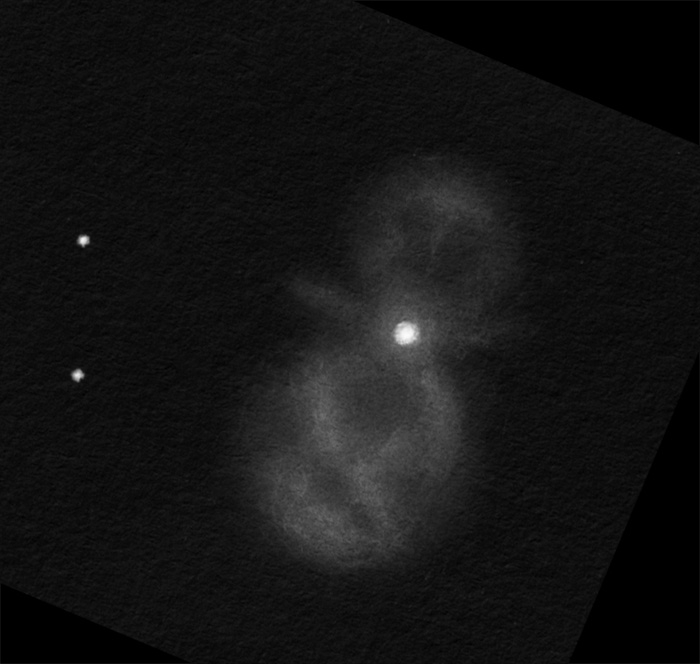
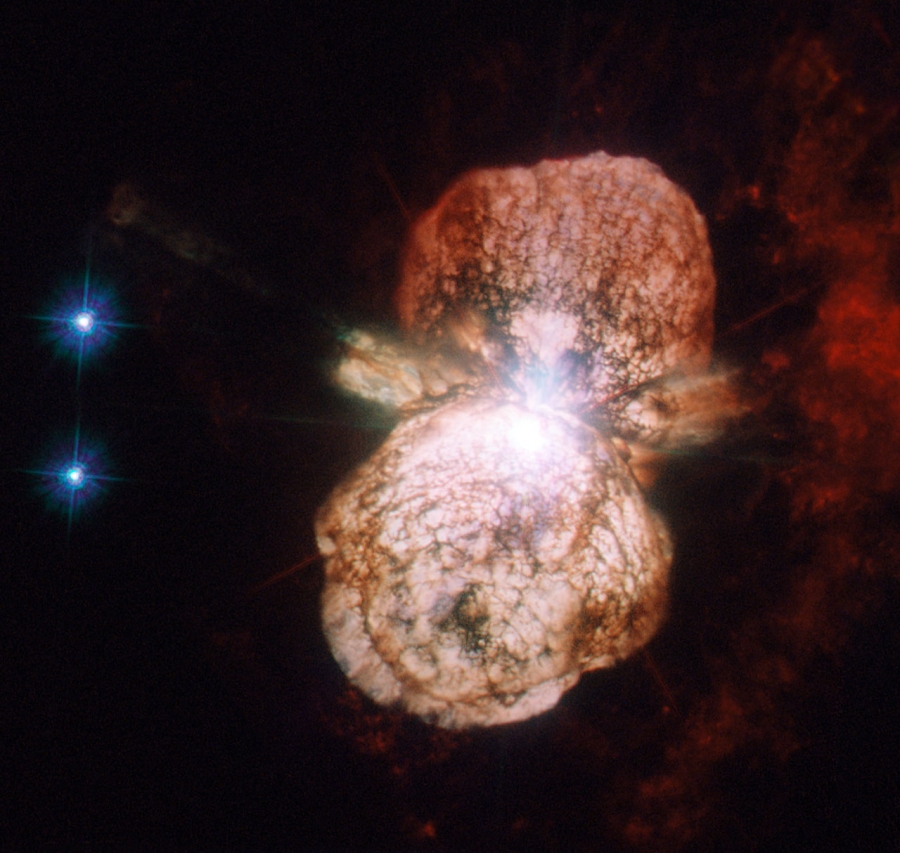
On the left you can see a photograph of the Homunculus and the immediate surroundings of Eta Carinae taken by the Hubble Space Telescope and published in 2012. I rotated my inverted drawing so that the field of view roughly matches. The corners are filled with black because the photograph covers a larger area.
The Hubble Space Telescope (among other telesopes) is regularly used to capture images of the Homunculus. The cloud of material ejected during the outburst is continuously expanding and changing. Meanwhile, Eta Carinae itself remains highly active, having steadily brightened throughout the 20th century. The appearance of the Homunculus is also influenced by clouds of material in the star's immediate vicinity, causing the entire nebula to change dynamically from year to year. Eta Carinae is a massive, luminous blue variable (LBV) star nearing the end of its life. It is also a binary system consisting of at least two components, one of which is destined to explode as a supernova in the near future (in astronomical terms). Both members of this binary system are hot, massive, blue stars orbiting each other with a period of approximately 5.5 years. Meaning these two stellar monsters are incredibly close to each other. I encourage everyone to read up on this system, located about 7,500 light-years away. It is a truly extraordinary object.
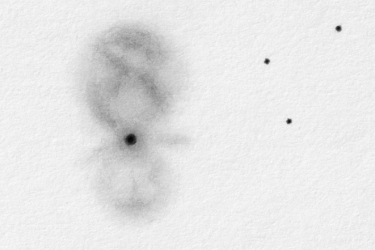
Carina diffuse neblua
Ejection cloud of the Great Eruption of Eta Carinae in 1838-43
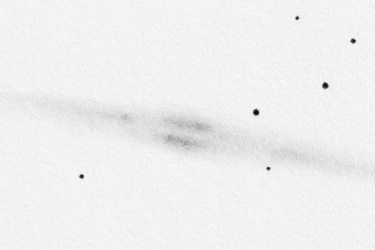
Antlia galaxy
Edge-on spiral galaxy in Antlia
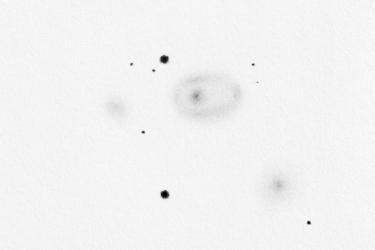
Volans galaxy
Interacting ring galaxy in Volans
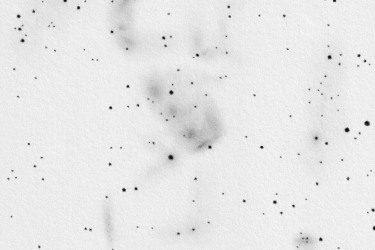
Carina diffuse nebulae
Highly structured emission nebula complex in Carina
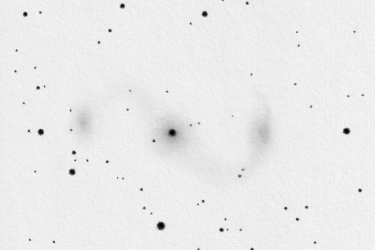
Norma diffuse nebula
Really unique diffuse nebula in Normában
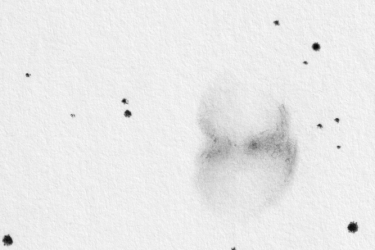
Vela planetary nebula
Planetary nebula in the thick Mily-Way fields of Vela