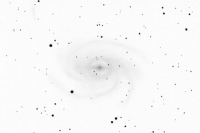



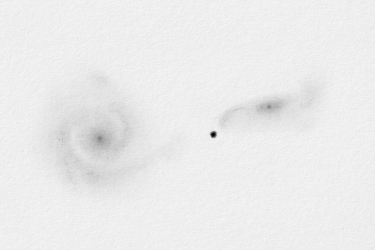
NGC 2442 was my main target in our 2016 Namibian trip along with the Tarantula Nebula. I started to draw it straight on the first night I got to use the 16" Dobsonian. The galaxy is very spectacular. It totally lived up to my expectations. The whole galaxy is bright though relatively diffuse. The nucleus is very bright and almost stellar. The spiral arms are very spectacular and detaild with several bright spots. The bar of NGC 2442 is not obvious either on photos or in my drawing. The two bright spots on my drawing closest to the core represent the ends of the bar. The bright spost are mostly star forming regions or the combined light of a few of them. I could describe theit positions in detail but I think everything is visible in the drawing. With a bigger telescope it would maybe be possible to spot the dust lane running along the spiral arms. But the 40 cm Dobsonian was insufficient for this.
I could see details in the neighbouring PGC 21457 as well but the spiral structure remained hidden. This galaxy lies in approximately the same distance as NGC 2442 hence it is a true neighbour.
There is no consensus yet on the subject of what caused the distorted shape of NGC 2442. One hypothesis is a possible former close approach with PGC 21457. Another possibility is the interaction with the intergalactic medium that NGC 2442 is flying through. Besides the shape another peculiarity is that a neutral (non-ionized) hydrogen (HI) cloud can be found very close to NGC 2442 as big as the galaxy itself. This cloud, namely HIPASS J0731-69 was probably ripped off from NGC 2442. It does not contain any stars therefore it cannot be detected in visible light only in radio (21 cm wavelength).


On the left you can see the European Southern Observatory's photo of NGC 2442 made with the 2.2 meter MPG/ESO telescope. The photo depicts a wider field than my drawing which I rotated to match the photo's orientation. I think it is pretty obvious why NGC 2442 was so high on my list.
PGC 21457 can be seen to the right on the photo. It is worth noting that I could see only the inner brighter region of this galaxy.
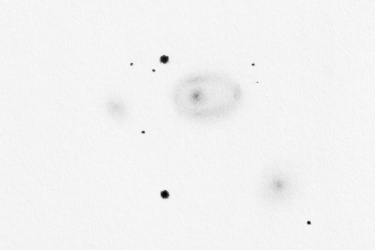
Volans galaxy
Interacting ring galaxy in Volans
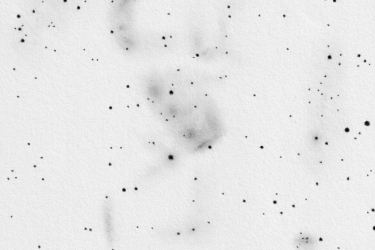
Carina diffuse nebulae
Highly structured emission nebula complex in Carina
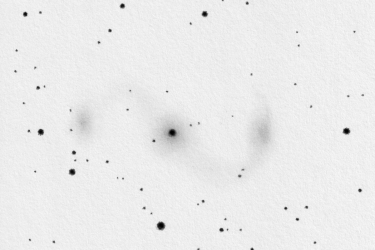
Norma diffuse nebula
Really unique diffuse nebula in Normában
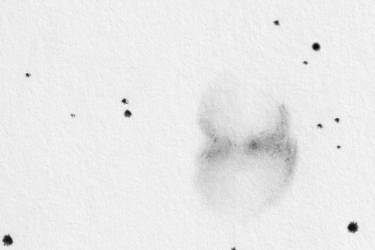
Vela planetary nebula
Planetary nebula in the thick Mily-Way fields of Vela
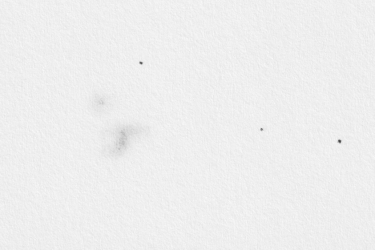
Phoenix galaxies
Entangled interacting galaxies in Phoenix
Virgo galaxies
Arp 271 interacting galaxies in Virgo