


The observers of the Souhern Hemisphere can call themselves lucky to be able to access such beauties in the sky. You don't need to struggle for hours to spot the barely visible details. You just take a look into the eyepiece and an incredible spiral galaxy greets you. NGC 2997 is really bright (9.4m) and quite big (more than 8'). Furthermore the spiral arms show a lot of contrast. They are not as tenuous as those of NGC 6744.
The nucleus is very bright and non-stellar. This is surrounded by a bright circular region. The two main arms start a little further out. Numerous details are visible in the arms. A couple of the spots are inhomogenious. The bifurcation of the right arm is a spectacular detail as well near the 11.4m bright foreground star. The other foreground stars are in the 15-16m range. A lot could be written about the position of the bright parts of the arms, areas with more or less contrast, etc. But I think the drawing speaks for itself. These are moment that remain etched into your mind.


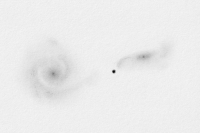
You can see the ESO (European Southern Obervatory) photo of NGC 2997 on the left. The photo was taken with the HAWK-I instrument mounted on the 8.2 meter 4th (Yepun) unit of the VLT. The HAWK-I operates in near infrared so the photo was not taken in visible light. This questions the whole point of the comparison. But the morphology of the galaxy is not really different in visible and near infrared so it might be worth including it here. I cropped my drawing to show a similar field as the ESO photo.
Volans galaxy
Interacting ring galaxy in Volans
Carina diffuse nebulae
Highly structured emission nebula complex in Carina
Norma diffuse nebula
Really unique diffuse nebula in Normában
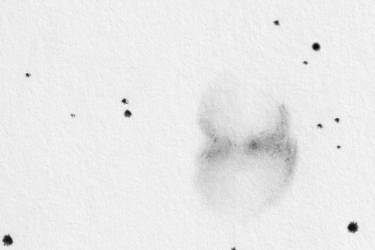
Vela planetary nebula
Planetary nebula in the thick Mily-Way fields of Vela
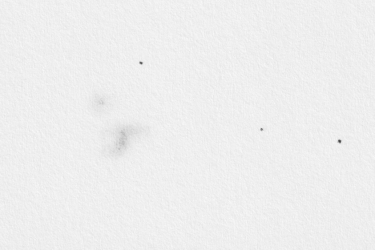
Phoenix galaxies
Entangled interacting galaxies in Phoenix
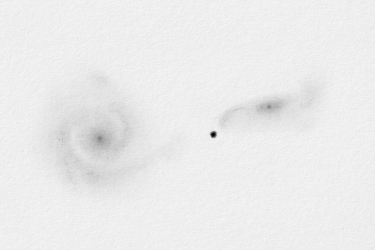
Virgo galaxies
Arp 271 interacting galaxies in Virgo